


How Your Online Reputation Can Make or Break Your Business
Your business might have the best products, the most innovative services, and a marketing strategy that turns heads. But in today’s digital world, one factor can overshadow it all: your online reputation.
People don’t just buy products or hire services. They buy trust. And increasingly, your reputation is often the first interaction they have with your brand. Whether it’s a Google review, a post on social media, or a rating on an industry-specific platform, potential customers are forming opinions before they even speak to you.
In this article, we have listed 6 main points that your business reputation can affect, for good or for bad. Let’s dive into it!
Trust & Credibility: The Foundation of Success
Each review, rating, or comment contributes to your credibility. When someone searches for a product or a service online, they’re looking for certainty that they will receive what is promised. Positive reviews show credibility, while negative ones can quickly damage trust.
Trust isn’t abstract. It directly impacts performance because it shapes how customers behave:
- Higher-rated businesses convert more visitors into customers
- Buyers decide faster when confidence is high
- Customers spend more with brands they trust
- Trust drives repeat purchases
- Trusted brands recover faster from negative events
A great example of trust impact is the e-commerce industry, where even a small advantage from competitors can destroy your entire brand. Here, strong ratings are not an optional feature; they’re the main sales leverage, along with the price, since online buyers would be focused on two main things: affordability and reliability. Rating is everything in online commerce, since your buyer can’t touch or test the product; he or she can solely rely on previous buyers’ reviews.
Check out this table derived from Amazon data, the world’s largest marketplace:
| Metric | Product A: "High Reputation" (4.5 Stars or higher) | Product B: "Average Reputation" (3.5 Stars or lower) | The Performance Gap |
|---|---|---|---|
| Average Monthly Sales Volume | ~5,000 Units | ~1,200 Units | ~4x Sales Volume |
| On-Page Conversion Rate (CVR) | 28.50% | 12.10% | >2x Conversion Rate |
| Search Visibility (Organic Rank) | Top 5 for Main Keywords | Page 2 or 3 for Main Keywords | Massive Visibility Advantage |
| Advertising Efficiency (RoAS) | 5.2x RoAS | 2.8x RoAS | Nearly Double the Ad Efficiency |
| Customer Acquisition Cost (CAC) | ~$4.50 | ~$9.00 | 50% Lower CAC |
Only one unresolved complaint can hurt years of hard work. That’s why checking reviews and feedback frequently and responding professionally is essential. Customers know when a business is proactive and transparent.
But credibility goes beyond reviews. The brand’s presence across platforms and the feedback of real customer experiences all work together to confirm trust.
People prefer brands and businesses they trust and stay loyal when they feel confident in their integrity.
Sales
If you look at your business as a mechanism, sales would be the fuel. No sales mean no cash flow; without cash flow, your “machine” can’t move on. Everything depends on the cash flow: the rent, the salaries, the marketing. And if you have to stop the marketing, the result would be even fewer sales.
Suddenly, your sales drop to 30%-40% in a single month. What the heck, you are asking yourself. Why? And sometimes you just need to check your Google Business Profile to find out the quick answer.
Yes, even if you build kitchens or exchange car oil, your reputation is highly important. There is no magic in this statement; we have already lived for more than 2 decades in a fully digital space, where businesses can’t hide anything and prospects have easy ways to find out about product or service quality. And we all use it; a reputation check is not a feature anymore, it’s a part of regular customers’ journeys. Before ordering anything from either a marketplace or our neighbor’s bike repair shop, we check what the quality is. In 2025, with the AI tools incorporated in our search, it became even easier; we don’t just find products or services, but we search with intent to find better quality in mind. All of us type in something like “Suggest a list of popular dog groomers in my area” or “Find a reputable web design agency in the Denver area,” basically adding an extra layer of search focus to eliminate any business with a lower reputation score.
Below is an approximate table on how your online reputation can impact your sales:
| Star Rating (based on 1 to 5 stars) | Consumer Sentiment | Estimated Sales & Conversion Impact (industry average) | Why This Happens (behavioural consumer psychology behind) |
|---|---|---|---|
| 4.5 – 5.0 | Exceptional / Trustworthy | +20% to +30% Increase while comparing your business with competitors | This is the "Optimal Trust Zone." It acts as powerful social proof. Consumers believe your product/service is premium and are often willing to pay more for it. |
| 4.0 – 4.4 | Strong / Reliable | +10% to +20% Increase (baseline for modern success) | This is the minimum target for most B2C businesses. It signals a reliable product or service with a high probability of a positive outcome. It maintains steady customer acquisition. |
| 3.5 – 3.9 | Average / Acceptable | Neutral / Baseline could lead to -10% potential sales drop | Customers may hesitate. This rating suggests your product is "fine," but they will often choose a 4.0+ competitor if pricing and features are similar. It is a competitive disadvantage. |
| 3.0 – 3.4 | Questionable / Risky | -10% to -25% drop in potential sales | A "3.x" rating is a warning sign. It suggests a significant number of negative experiences (e.g., poor quality or service). You are now losing a quarter of your potential customers to better-rated options. |
| 2.5 – 2.9 | Poor / Undesirable | -30% to -50% Drop in potential sales | This is the "Danger Zone." Over half of your potential customers will filter you out immediately in search results. Acquisition relies heavily on being the absolute cheapest option. |
| 1.0 – 2.4 | Toxic / Unreliable | -70% to -90%+ Drop in potential sales | A "1.x" or low "2.x" rating signals systematic failure, poor ethics, or a product that doesn't work. The business is often unsustainable without a complete rebuild or rebrand. |
Sometimes, a worker with a negative attitude can destroy their employer’s business within a few weeks of work, causing upset customers to return this negativity in the form of bad reviews. The business owner will only discover this after he notices the sales drop and starts looking into it. And it’s especially dangerous for a new business that doesn’t have many reviews yet. If you have 3 reviews in total, and one of these is 1; your average becomes 3.6, and this is the number your prospect’s eyes capture first.
To sum up, low sales could be an indicator of reputation score changes, but try not to get to this point. Reputation is gained hard but destroyed easily.
Search Engine Optimization
How does reputation impact your company’s SEO and organic traffic? In two ways:
A. Your local Google listing ranking
Same as the general search engine results outputs, the GBP (Google Business Profile) heavily depends on the searcher’s behavior.
Google’s engine constantly compares visitors’ responses, including the CTR (click-through rate) that a particular website scores from being listed in the search results, as well as measuring time spent on the website. For example, if a particular company is constantly being skipped by searches (they avoid clicking it on Google’s search results), and even if they click it sometimes but then drop after a few seconds, it sends the search engine a signal that this website is not relevant to that search term. And this website is thrown away from the result.
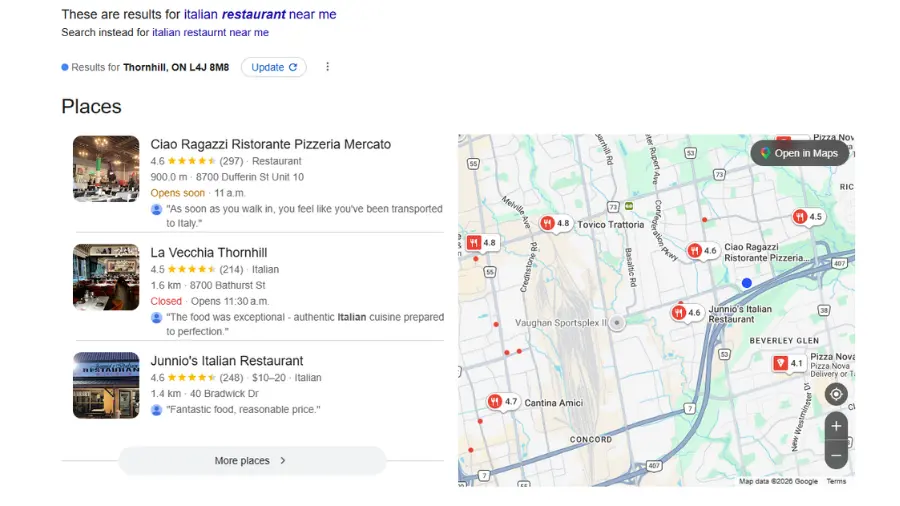
The same logic is true for your GPB that is represented in the “places” geographic results module. And local results’ relevancy is highly influenced by the reputation. You will only rarely see a company with a reputation of less than 4 stars at the top; the reason is that searchers simply skip it and don’t click it; low-reputation businesses just look fishy. The algorithm then gets a signal that this business is “unwanted” and pushes it to the end of the list, where no one will see it, and in some cases, throws it away from the local results at all.
B. AI search visibility
Generative search, or GEO, is the new generation of online search. Not only does it allow searchers to find what they need, but it also narrows results to the very focused, “chewed” answers that save 90% of time on the research. GEO adds new layers on top of a standard search, including the searcher’s intent, his or her previous behavior, more complex LLM context of the search, and a few more features. And one of the metrics that helps AIs to provide better results is the reputation of the company, or the brand.
If your business has a negative reputation, AI would simply not feature it in its answers. It will prefer to quote and include in its outputs a trusted company, based on the “social proof” associated with their brands or local reputation signals.
Stay Competitive: Your Reputation is Your Advantage
Winning the market is not always about getting better. Sometimes it’s about being noticed as better. And this perception is influenced by your reputation.
Your online reputation affects the decisions of your consumers and even serves as social proof, as being in your industry is such an important element to compare your brand to the brand you like the most. If companies market the same products or services, then reputation plays a role when two businesses market products (and less so if they’re different). Consumers generally recommend brands with better ratings even if they have lower prices.
Good reputations affect decision-making as well as the market performance of companies overall.
Another way of understanding the effect of reputation is by comparing how brands operate in the same space but are perceived differently.
Take the Coca-Cola Company and PepsiCo. Both are global beverage leaders in more than 200 countries, with extensive distribution networks and similar product categories.
However, the carbonated soft drinks that we look at make the key difference in brand strength:
U.S. Market Share (Carbonated Soft Drinks – 2023). Coca-Cola is 69%; Pepsi is 27%.
Despite competing in the same category, Coca-Cola is a much larger player, not because of distribution or availability but due to its more loyal reputation for the brand and long-term trust.
Over the years, Coca-Cola has created a brand with consistency, emotional connection, and global identity.
This perception influences consumer purchase when the choice exists. People often will choose the brand they trust and feel connected to for comparable reasons. It is something like that.
When products are similar, reputation becomes the decision-making factor, and a highly trusted brand wins.
Reputation builds up and grows significantly over the years. Every positive review and every public encounter helps in more visibility in search results. It gives you stronger brand recall. And stronger long-term positions. This, over time, breeds a continued positive feedback loop based on more trust, more customers.
Talent Acquisition: Attracting the Best People
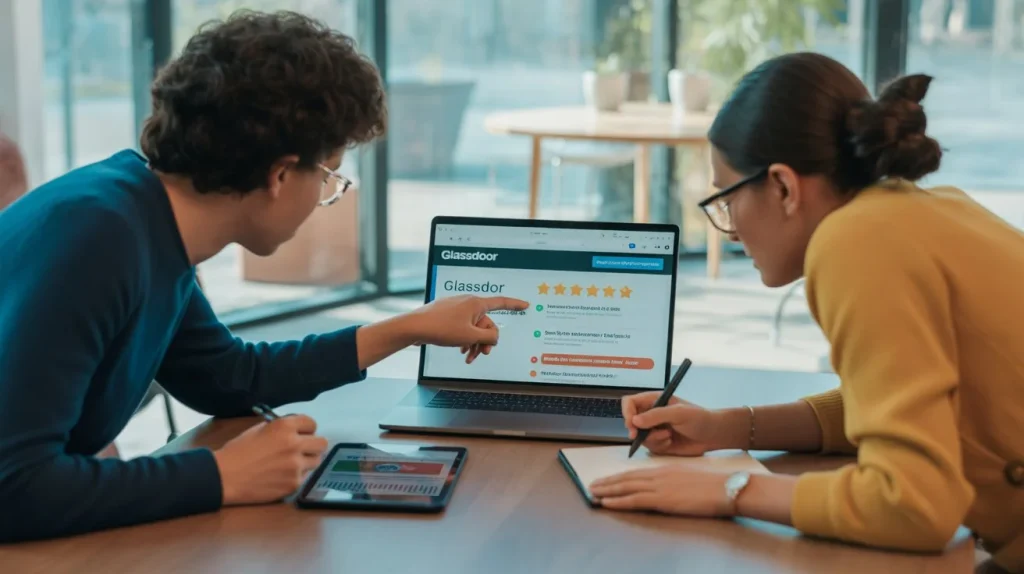
Your online reputation is important for how your customers believe it on the internet, in your case. It is also important to an employee’s perception of you. Platforms like Glassdoor have made job-seeking prospects able to see things from behind the scenes.
One could argue, “Why should a company care about ’employee reputation’?” It doesn’t serve its workers; it should be focused on satisfying the end client”. Let me give you an example of why.
At one time in my career, I got to work in a very toxic environment. A retail company, whose owner couldn’t control its behavior. He was extremely demanding of his workers, and instead of showing his appreciation by giving bonuses or improving work conditions, he tried to block any incentives, even the ones that were written inside the contract. In short, he had a greed problem on a very serious, almost “clinical” level.
I shouldn’t tell you that the average lifespan of the worker was about 6 months. I won’t even mention the number of lawsuits this “terrible boss” received on an annual basis; these are all business troubles, but they are only relevant after talent acquisition. The issue was that the ex-workers had a huge urge to share their disappointment, and they used virtually every corner to do it: Glassdoor, Indeed, and even regular company reputation properties, such as Google profiles or social media profiles.
So at some point, after internal issues were spread all over the web, they had become very hard to miss. And the only workers this company could now hire were new workers without any experience, newbies who needed some “entry point” to start their careers. Or, low-quality people who couldn’t pass interviews in any other place. And after a while, the poor “human capital” of this company started to affect all other aspects: marketing, logistics, customer service, and clients’ satisfaction.
This wasn’t a new company. They were in the business for 30 years before “employment” reputation signals started to pop up. Twenty or even ten years ago, it wasn’t easy to get internal insights, but the technology has moved on, and the internal issues have become external. Guess how this company has ended.
Top talents are selective. They conduct research, and a few bad results on the internet can send a potential “star worker” away. On the other hand, strong companies that own a good workplace reputation do better; they will attract a lot of good candidates and build stronger teams while definitely saving on hiring expenses.
And there’s also retention. If people join a company they already like, they get to know it well, feel motivated, and are more likely to speak positively about it. And at a later stage, they will become advocates for the brand, which builds goodwill with clients and future customers.
Industry-Specific Platforms: Where It Matters Most
Different industries rely on specific platforms to gain visibility and get leads. For contractors and home services, HomeStars attracts high-intent prospects. TripAdvisor is the major source of reputation checks for restaurants and tourist attractions; this platform is a major factor affecting customer decisions. The healthcare industry, real estate, automotive, and even marketing services all these sectors have their own little hubs where their customers exchange feedback and rate companies.
Most of all, companies that actively engage on their business platforms consistently outperform those that do not. Across industries, what is the general pattern?
| Metric | Active on Platforms | Inactive / Neglected |
|---|---|---|
| Lead Generation | +30% to +60% more inbound leads | Lower volume and more reliance on paid ads |
| Organic Visibility | Strong presence in search & local platforms | Limited visibility or buried listings |
| Conversion Rate | Higher (due to trust signals) | Lower due to uncertainty and no engagement reviews |
| Reputation Score (NPS proxy) | +20 to +40 points higher on average (If it is supported by active review engagement) | Lower satisfaction and weaker brand perception due to a poor or no review interaction |
Based on aggregated industry data and supported by research from the Spiegel Research Center and Harvard Business School findings on review impact.
Being proactive on these platforms is more than just presence: it is credibility, customer service, and professionalism. Businesses respond to reviews at all times, update profiles regularly, rapidly troubleshoot complaints, and showcase positive feedback to shape customer perception.
From a search point of view, platforms prioritize quality interaction and engagement with their customers (responses and updates). This means active businesses are more likely to rank higher on platforms and in Google local results, which helps increase organic traffic without spending more on ads.
Neglecting these platforms can cause a deterioration of performance in the long term. Today’s customers don’t rely on a single platform. They look at multiple platforms to make their decisions.
If they encounter:
- Outdated information
- Unanswered negative reviews
- Low review volume
They just proceed unafraid and move on, without stopping to think about the rest of it. In many cases, the question isn’t “who is the best choice” but rather “which one feels the safest?” Inactivity raises doubts and creates fear about what one might lose.
As reputation management tools have evolved in this space, this work can now function centrally and be distributed as efficiently as possible. You can monitor reviews from a variety of platforms at once and respond quickly and consistently. Make sure the best customer testimonials are up to date.
We know being present is not enough. Businesses that actively manage their reputation across industry platforms not only look better than those on other platforms but also generate higher leads and convert more customers.
The New Reality: Control and Recovery
The good news is that with proper reputation management, you can recover from past issues. For instance, Google Business Profile reviews can sometimes be removed after a while if they violate guidelines, helping you maintain a clean, professional image.
Technology also allows businesses to monitor mentions, respond instantly, and create a consistent presence across multiple platforms. Today, reputation management is more than damage control. It’s a strategic advantage.

Take Action: Protect and Grow Your Reputation
Online reputation management isn’t optional anymore. It is a requirement. A solid reputation can drive conversions, build loyalty, and even increase the lifetime value of your clients. If you never think about these topics, you may erode your business growth.
The question isn’t whether you care, but whether you’re taking proactive steps to protect your online presence. Protect it, boost it up, and make use of it to enhance your digital footprint.
And if you require assistance, feel free to talk to IDL Web experts. Not only do we manage social media, but we also strengthen, protect, and promote your reputation, and we know how to deal with removing negative reviews. We can help you plan a reputation strategy based on trust that attracts employees and converts prospective customers’ loyalty and potential to the brand.